LIFE SWITCH2O
Sustainable wastewater innovation towards circular H₂OProject 101212626 — LIFE24-ENV-NL-LIFE SWITCH2O
The ambitious goal of LIFE SWITCH2O is to demonstrate an innovative, decentralized, and fully circular wastewater treatment solution in the Noorderhoek district in Sneek. This approach can be scaled up to districts across the Netherlands and Europe. In doing so, the project lays the foundation for a breakthrough in achieving the circular economy, in line with the climate targets for 2050 in the Netherlands and elsewhere in Europe. LIFE SWITCH2O aligns perfectly with the objectives of the Circular Economy Action Plan and makes a valuable contribution to the Urban Waste Water Treatment Directive.
Objectives of LIFE SWITCH2O
- Reduce the use of clean drinking water;
- Produce household-/drinking-water-quality water from wastewater;
- Ensure maximum nutrient recovery without micro-pollutants;
- Develop an integrated and optimized energy recovery system;
- Enable direct local reuse of water and nutrients;
- Increase stakeholder engagement;
- Develop a replication plan, including a blueprint for the governance structure and scaling up.
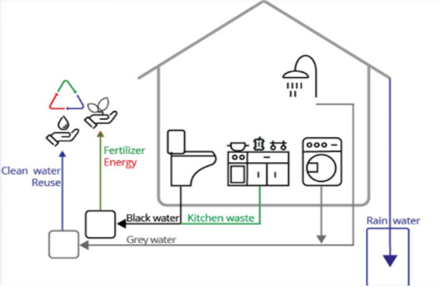
Schematic representation of the SWITCH2O approach
Noorderhoek, Sneek
The project covers 207 homes (145 houses and 62 apartments) in the Noorderhoek district in the Frisian city of Sneek in the Netherlands. The project provides solutions for water shortages caused by climate change, the looming scarcity of primary raw materials, and the environmental pollution associated with traditional wastewater discharge, by demonstrating a unique combination of treatment technologies, including thermophilic digestion, nanofiltration, reverse osmosis, electrodialysis reversal, and UV treatment. These technologies result in pathogen-free nutrients and drinking-water-quality water, which can be safely reused in various profitable applications.
What LIFE SWITCH2O Will Deliver
Within five years after the end of the project, LIFE SWITCH2O will have already identified 21,000 homes in Europe where the approach can be replicated. In addition, the recovered water is expected to be validated as drinking water, leading to a 99% reduction in the use of primary clean drinking water.
Within 10 to 15 years after the end of the project, most Dutch and other European municipalities could switch to circular, decentralized wastewater systems. This would reduce pressure on surface water and groundwater for drinking water production by 25%—and in some cases even by up to 99%.
In terms of water, nutrients, and energy, wastewater systems could shift from being a costly consumer to a profitable producer. This is a fundamental and extremely important transition if the Netherlands and other EU countries want to achieve their goal of being fully circular by 2050.
Partners
The LIFE SWITCH2O consortium is led by the regional water authority and coordinating beneficiary Wetterskip Fryslân and also includes the municipality of Súdwest-Fryslân, housing corporation Elkien, technology developer Desah, knowledge institutes the European Centre of Excellence for Sustainable Water Technology (WETSUS), the Foundation for Applied Research in Water Management (STOWA), and drinking water company Vitens, as well as replication partners the Schieland and Krimpenerwaard Water Board (HHSK) and the Swedish drinking water company NSVA.

Waterschoon and LIFE SWITCH2O: The Road Towards a Fully Circular Water System
In 2006, the Nieuwe Sanitatie Lemmerweg project started with a proof of concept for circular neighborhood-level wastewater treatment in Sneek, involving 32 homes. Four years later, this concept was scaled up in the Noorderhoek district through the Waterschoon pilot project, in which 207 homes participated. In this pilot, innovative technologies were applied, such as water-saving vacuum toilets, separate collection of wastewater streams, and a small-scale digester. This made it possible to recover, among other things, biogas and nutrients such as struvite.
The results showed that decentralized neighborhood-level wastewater treatment is technically feasible. With the LIFE SWITCH2O project, the next step is now being taken: the development and demonstration of a fully circular water system in which water, energy, and nutrients are reused to the maximum extent. The project therefore serves as an important example for sustainable residential districts in Europe.